 Register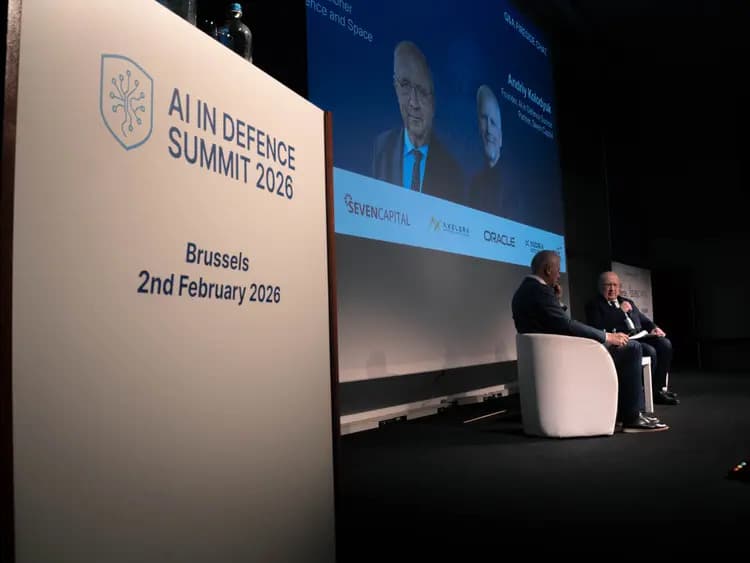
European Sovereign AI Defence: Why 2027 Changes Everything
European defence raised $8.7B in 2025, but Anduril alone ships $2.1B annually. Why sovereign AI infrastructure, not just startups, determines European independence.
Short answer: European defence tech raised $8.7B in 2025, but faces a structural scale gap: Anduril alone generates $2.1B in annual revenue, outpacing Europe's entire year-on-year venture raise. Sovereignty in AI defence now depends on building the hidden layers (sensor fusion, edge autonomy stacks, decision-support platforms), not just funding startup airframes. The 2027 window closes fast: without integrated policy, procurement alignment, and venture capital density, Europe's defence AI will remain dependent on US architecture.
Sovereign AI defence means military AI systems designed, built, and operated entirely within European supply chains and governance frameworks, spanning sensors, algorithms, compute infrastructure, and decision loops, independent of US or allied black-box dependencies.
Key Takeaways
- Scale vs. startups: European defence raised $8.7B in 2025, but Anduril's $2.1B annual revenue shows the gap between capital and operational output. Watch revenue, not just rounds.
- The hidden layers win: Helsing's $18B valuation signals software-defined defence is winning, but the real moat sits in edge autonomy, sensor integration, and decision support under the airframe. That's where serious capital gets fielded.
- Sovereignty is infrastructure: Sovereign AI defence isn't a startup thesis. It's a policy + procurement + capital stack that doesn't yet exist at European scale. Closing the gap requires all three moving together by 2027.
- The window is now: NATO procurement cycles, EU defence budgets, and venture capital concentration mean decisions made in 2026–2027 lock European capability for the next decade. Delay costs scale.
Europe's Sovereign AI Defence Gap Widens Fastest in the Invisible Layers
Helsing's $1.2B Series C at an $18B valuation proves the thesis: software-defined defence wins. But Europe's $8.7B annual defence-tech raise in 2025 trails US capacity by orders of magnitude, and the gap accelerates fastest in the layers that actually decide conflicts: sensor fusion, edge autonomy stacks, and real-time decision support.
Scale asymmetry is structural, not cyclical. Anduril generates $2.1B in annual revenue, nearly one-quarter of all European defence-tech capital raised in a year. One US company. That gap compounds when you look deeper: the sensor-to-decision pipeline, the edge inference layers where latency kills, the navigation and positioning stacks that operate when GPS fails. These are not glamorous. They do not appear in funding announcements. They are where European defence strategy either closes or collapses.
The problem is not Helsing or the founders. Helsing is executing at scale. The problem is the infrastructure beneath software-defined warfare remains fragmented. European defence procurement still buys platforms. It does not yet buy stacks. When you buy a platform, you inherit its sensor architecture, its navigation assumptions, its latency profile. When you buy a stack, you own the decision loop.
That distinction matters for 2027 because the window to build sovereign capability in these invisible layers is closing. US defence AI is consolidating around integrated stacks. Chinese defence is moving faster in edge autonomy than Western procurement cycles permit. European strategy still treats AI as a feature bolted onto legacy platforms, not the foundation of warfare itself.
The stakes for procurement leaders: If you are directing defence capital in 2027, you are not choosing between AI vendors. You are choosing between buying platforms with US sensor assumptions baked in, or investing now in European-sovereign edge-autonomy stacks that may not reach maturity until 2029–2030. That delay is the cost of sovereignty.
Why Helsing at $18B Signals the European Defence Tech Inflection, and What It Reveals About the Layers That Win
Helsing closing ~$1.2B at an $18B valuation is not a funding milestone. It is proof that European software-defined ISR and targeting stacks now command capital at US scale. The signal matters less than what it reveals: the market has stopped betting on platforms and started pricing the hidden layers underneath. Sensor processing, real-time decision support, and autonomous edge execution are where the margin and the moat live.
Compare this to the broader context. European defence startups raised $8.7B in 2025, a 55% jump year-over-year and a genuine acceleration. But Anduril alone generated $2.1B in revenue in the same period. One US company's annual sales exceed the entire European venture pool. That gap is not closing; it is reshaping which layers get funded.
Helsing's valuation tells you where capital sees asymmetric return: not in airframes or chassis, but in the stack that sits between raw sensor input and firing decision. The company builds software that fuses multi-source ISR data into targeting recommendations under latency constraints. It is, in effect, a decision-support system operating in the millisecond margins where humans cannot compete. That is a defensible, scalable, and exportable layer.
Watch the services model, not the hardware. Helsing's valuation is anchored to recurring software revenue and integration contracts, not unit sales. European defence procurement historically bets on platforms you can photograph. The shift to decision layers means you are now pricing software that sits behind classified networks, embedded in third-party systems, and accessed via subscription or usage-based models. That is a different buyer psychology, a longer sales cycle, and a higher customer lifetime value.
For your portfolio: if you are still evaluating defence tech bets on hardware differentiation or sensor novelty alone, you are watching the wrong layer. Helsing's signal is that the companies that win at $18B+ valuations are the ones that own the middleware: the layer that converts sensor noise into actionable intelligence in real time. That layer does not require you to build missiles or compete with Lockheed. It requires you to ship decision software that integrates, learns, and survives in contested environments.
The Anduril Precedent: Why Revenue Matters More Than Rounds in Sovereign Defence Scaling
Anduril generated $2.1B in revenue in 2025. Europe's entire defence-tech startup ecosystem raised $8.7B that same year. The difference is not funding. It is production at scale. Most European capital sits in pre-revenue or Series A rounds; Anduril ships autonomy stacks that get fielded. Europe is building venture portfolios. The US is building defence companies.
This distinction matters because it reveals where European strategy has misaligned with the problem. When Helsing closes an $18B round, the signal Europe reads is "we have deep tech momentum." The signal a procurement officer reads is "software-defined defence is real, and we need it." Between the two signals sits a gap: $8.7B in venture funding does not equal $2.1B in annual revenue. The gap is production readiness, supply chain integration, and the unglamorous work of scaling a defence contractor.
Anduril's path was not unique to the US. It was unique in the urgency. The company faced a customer base (US DoD, US Special Operations) that could absorb volume and fund iteration in parallel. European startups face fragmented procurement across NATO members, longer approval cycles, and no single customer with Anduril's scale. The capital followed because the revenue was certain.
The Production Gap Is the Real Constraint
European defence budgets are rising. Capital is flowing. But capital does not become production without three things: a customer willing to absorb volume, technical specifications that integrate with existing systems, and a supply chain that can actually deliver. Startups solve the first problem. None solve the last two at scale.
Watch where European money should move: not to the tenth autonomy startup, but to the production infrastructure beneath it. Sensor fusion at the edge. Navigation stacks that don't require GPS in contested environments. Decision-support layers that integrate with existing C2 systems. These are lower-margin, less venture-friendly problems. They are also the problems that actually get a system fielded. Anduril's revenue came from solving them, not from funding another round.
The 2027 shift: Europe's procurement strategy must move from "fund startups with IP" to "accelerate startups into prime contractors with production commitments." That means long-term volume contracts, integration roadmaps, and patience for the years between seed and fielding. It is the opposite of venture velocity. It is how Anduril won.
The Services Model: Where European Defence Companies Actually Win Procurement
European defence companies win fastest where US scale becomes a liability: recurring software services, managed edge operations, and decision-support subscriptions. These models generate sticky revenue, compress procurement cycles, and sidestep the manufacturing bottlenecks that slow hardware vendors. Watch the services model more than the airframes. It is where European companies ship faster than US scale requires.
Quantum Systems demonstrates this at volume. The company ships autonomous ISR platforms but generates recurring revenue through managed flight operations, sensor-data processing, and operator training subscriptions. Each customer renewal is a contract renewal; each new capability is a software push, not a manufacturing ramp. That recurring-revenue structure lets European vendors iterate faster than companies betting on capital equipment sales.
Why this matters for procurement: defence budgets pay for outcomes (accurate targeting, reduced dwell time, lower operator fatigue), not airframes. A services contract aligns the vendor's incentive with the customer's result. European primes have learned this faster than US scale allows; US vendors still chase volume production of hardware, which locks them into long product cycles and inventory risk.
The procurement advantage runs deeper. Services contracts are easier to fund from operational budgets (not capital allocation), faster to approve, and simpler to scale across allied nations. A NATO customer can buy flight-ops services from a Brussels-based vendor without rebuilding supply chains. That's why Alpine Eagle and similar European operators are winning integrated ISR contracts where US competitors are still negotiating exclusivity deals.
European defence capital should track services revenue as the lead indicator, not shipment volume. A company with 70% recurring services revenue and a 3-year customer retention rate has already won the execution model that closes the capability gap. Hardware comes second.
NATO AI Capability Gaps and Where European Sovereign Capabilities Must Be Non-Negotiable
Europe's sovereignty mandate now overrides cost in defence procurement. NATO's AI capability gaps centre on three non-negotiable layers: sensor-to-decision loops that work under contested spectrum, autonomous navigation when GPS is denied, and targeting that holds under information operations. You cannot outsource these to vendors outside your control without ceding operational decision-making to a foreign power.
The gap is widening fastest where it matters most. Helsing closed $1.2B at an $18B valuation, a European win, but the company's edge lies in data fusion and decision support under uncertainty, not in the platforms themselves. That distinction matters: Europe has platforms. It lacks the sensor-integration and autonomous-navigation stacks that prevent an adversary from blinding or spoofing your decision loop.
Anduril generates $2.1B in revenue partly because it ships the full stack: sensors, processing, autonomous tasking, and the software that binds them in denied-access environments. European startups raised $8.7B across all defence sectors in 2025, but that capital is split across 50+ companies, most pre-revenue. Scale concentration matters. The US does not debate whether autonomy-under-GPS-denial is core capability; it funds three companies to win that layer and lets competition sort survivors.
Sensor-to-Decision Under Spectrum Denial
Real-time targeting in a jammed environment requires sensor fusion that runs on your own hardware and software, not on cloud APIs. Europe has built radar and SIGINT sensors. It has not built the edge-autonomy layer that fuses those sensors and makes firing decisions without waiting for a command from a bunker 500 km away. That is the gap. Procurement policy now treats that gap as non-negotiable.
Navigation and Manoeuvre Without GPS
Quantum Systems and a handful of European UAS makers can fly drones autonomously. They cannot reliably navigate contested airspace when GPS is jammed. The US solved this at volume five years ago. Europe is still writing the specifications. Your procurement team now asks vendors not "Can you fly this drone?" but "Can you navigate it when an adversary owns the electromagnetic spectrum?" Saying yes to that question is now a mandatory contract requirement, not an option.
Targeting Under Information Operations
An adversary floods your network with false target data. Your AI system must reject bad signals and confirm legitimate targets through a degraded sensor array. That is not a feature; it is a survival requirement. European defence AI companies are building systems that assume network integrity. That assumption is wrong. Sovereignty means your own stack detects and rejects information operations in real time.
Procurement implication: European procurement teams are now adding clauses that ban cloud dependencies, mandate on-device processing, and require proof of resilience under spectrum denial. If your vendor's system breaks when GPS or comms are jammed, it fails the sovereignty test. This shifts budget from software licences to hardware integration.
How to Position Your Company for 2027 European Sovereign Defence Procurement
The 2027 procurement window is already closing for teams that haven't shipped. PESCO frameworks and European Defence Fund allocations tighten around sovereignty requirements (data residency, source code access, interoperability with NATO standards), and only vendors demonstrating volume production get the capital-to-scale rounds that Helsing's $18B valuation signals are now standard. If your product is still in pilot phase, you're competing against vendors who already have defence ministry contracts and supply-chain integrations. The decision-makers sitting in procurement offices this year are not evaluating technology; they're evaluating supply chains.
Three positioning moves separate fundable from unfundable in this window:
- Build for the services model, not the box. European defence budgets don't scale the way US military spending does. Your revenue model must work on per-operator licensing, managed autonomy, or outcome-based contracting, not on selling airframes or sensor suites outright. Quantum Systems proved this; watch how they layer services revenue over hardware, not the other way around.
- Design data sovereignty into architecture, not compliance. EU procurement criteria now require proof that training data, model weights, and inference logs stay within EU infrastructure. This is not a checkbox; it's an engineering constraint that splits your compute stack. Teams that haven't factored this into their design will need 18 months to retrofit, time you don't have.
- Ship before 2027. Pilot contracts close out in Q4 2026. Production contracts start Q1 2027. If you're still in trials, you miss the capital cycle entirely. European startups raised $8.7B in 2025, but that capital only flows to teams with signed LOIs or deployment milestones, not prototypes.
Founders: your go-to-market is not a pitch deck to venture capital. It's a six-month engagement with a defence ministry procurement office, usually mediated through a systems integrator or a NATO ally nation. That relationship starts now, not in Q2 2027. Investors: the second-order returns go to the enablers (the firms building the data infrastructure, the edge-autonomy middleware, the compliance platforms), not to the consumer-facing sensor vendors. The market is bifurcating between scale and specialisation, and European capital is concentrating on the gaps between them.
The signal: The AI in Defence Summit 2027 (1 March, Brussels) is where procurement teams announce next-year capability requirements, capital partners signal deployment thresholds, and policy makers finalise sovereignty frameworks. If you control a budget or a deployment timeline, this is where you clarify what "ready for procurement" actually means in 2027.